
Introduction
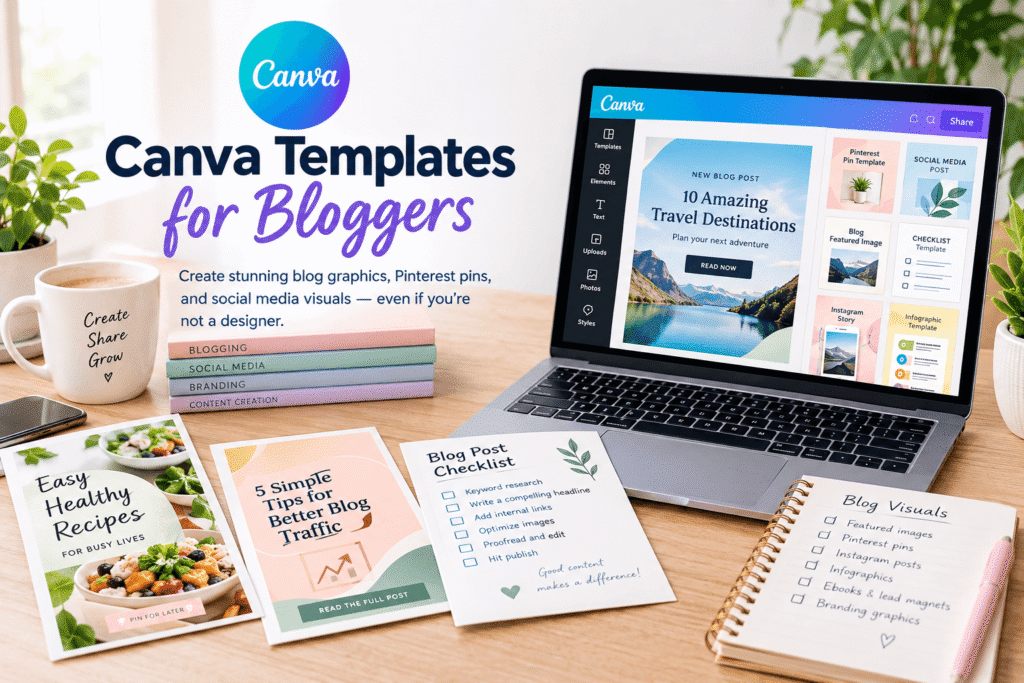
Canva Templates for Bloggers make it easier to create professional-looking blog graphics without spending hours learning complicated design software. Whether you run a lifestyle blog, travel website, food blog, business publication, or digital marketing site, the right templates can help you create consistent visuals that support your content strategy.
Blogging involves much more than writing articles. You also need featured images, Pinterest pins, social media graphics, promotional banners, and sometimes downloadable resources. Creating every design from scratch can take valuable time away from researching, writing, and updating your content.
Fortunately, Canva provides editable design templates that bloggers can customize with their own colors, fonts, images, and messaging. With a simple visual system, you can maintain a recognizable brand while publishing content more efficiently.
In this guide, you will discover useful Canva template types, learn how to customize them, avoid common design mistakes, and build a practical workflow for your blog.
Table of Contents
- Why Canva Templates Matter for Bloggers
- 10 Essential Canva Templates for Bloggers
- Benefits of Using Canva Templates
- How to Customize Canva Templates Step by Step
- Common Design Mistakes to Avoid
- Practical Checklist for Bloggers
- Take Your Blog Design Further
- Frequently Asked Questions
- Conclusion
Why Canva Templates for Bloggers Matter
Readers often encounter your blog through search results, social media posts, Pinterest, or recommendations. Clear and attractive visuals can help communicate what an article offers before someone starts reading.
A well-designed graphic also supports your website’s overall identity. When your colors, typography, and image style remain consistent, readers can more easily recognize your content across different platforms.
However, attractive design should serve a purpose. A featured image should communicate the article’s topic, while a Pinterest pin should encourage the right audience to explore the linked content.
Canva templates provide a starting point for these tasks. Instead of creating layouts from scratch, you can adapt existing designs to fit your editorial calendar and brand.
For example, a food blogger could use one template for recipe pins, another for weekly meal plans, and a third for printable shopping lists. A marketing blogger might create templates for tutorials, statistics, checklists, and case studies.
The objective is not to make every graphic look identical. It is to establish a consistent visual identity while giving each piece of content an appropriate design.
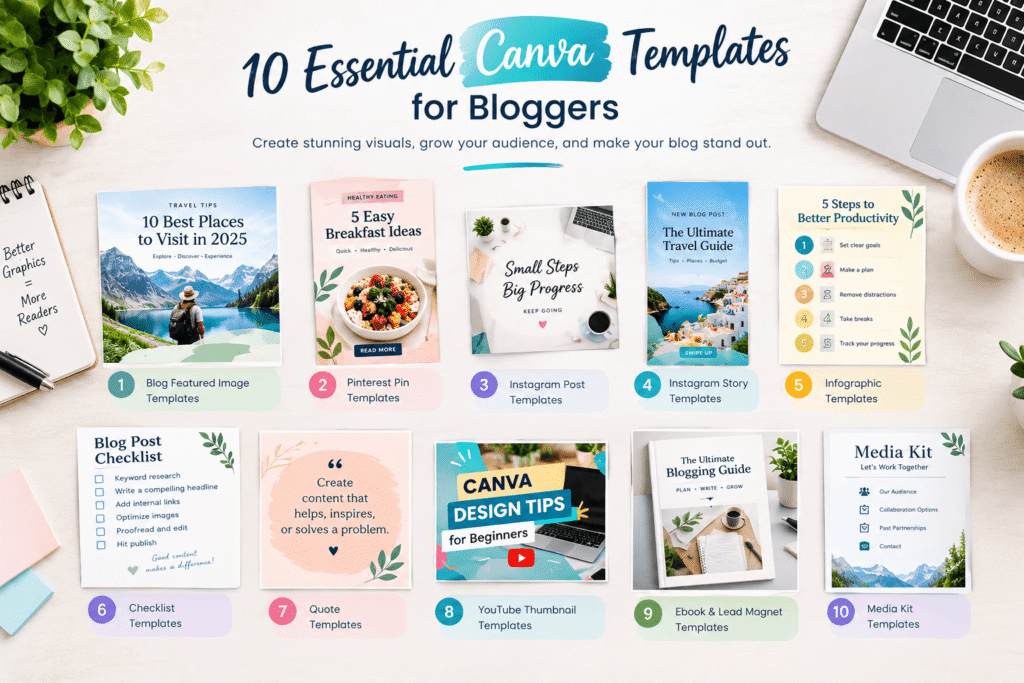
10 Essential Canva Templates for Bloggers
Different blogs need different graphics. These ten template categories cover many common publishing and promotional tasks.
1. Blog Featured Image Templates for Bloggers
A featured image introduces an article visually. It may appear at the top of a blog post, on category pages, or when the article is shared elsewhere.
Choose a layout with a clear headline, a relevant photograph or illustration, and enough empty space to keep the design readable.
For example, an article titled “Beginner Gardening Tips” could feature a photograph of gardening tools with a short headline and a small brand logo.
Keep the main text concise, and check how the image looks on both desktop and mobile screens.
2. Canva Pinterest Pin Templates
Pinterest graphics can help readers discover articles through visual search. Bloggers can use pins to promote tutorials, recipes, travel guides, product roundups, and evergreen resources.
Start with Canva’s Pinterest pin templates and select a layout that suits your niche.
Use a compelling headline, a relevant visual, and consistent branding. For example, a personal finance blogger could create a pin titled “7 Simple Ways to Organize Your Monthly Budget.”
Pinterest recommends creating mobile-friendly visuals and adding useful context to Pins. Review its creative best practices when developing your designs.
3. Canva Instagram Post Templates
Instagram graphics can repurpose your blog’s main ideas into bite-sized content.
Create templates for educational tips, quote cards, carousel posts, announcements, and article promotions. A travel blogger, for instance, could turn a destination guide into a carousel featuring the location, travel tips, estimated costs, and a final invitation to read the full article.
Keep text large enough to read on a phone. Each slide should communicate one clear idea rather than squeezing an entire article into a single graphic.
4. Instagram Story Templates for Blog Promotion
Story templates are useful for sharing new articles, asking questions, promoting resources, and directing followers to relevant content.
Design a few reusable layouts with space for a short message, a photograph, and a call to action. You can adapt these designs for new posts without rebuilding the entire layout.
5. Canva Infographic Templates for Bloggers
Infographics help explain information visually. They are particularly useful for educational blogs, tutorials, business publications, and research-based articles.
For example, a digital marketing blogger could create an infographic explaining the stages of a content marketing campaign.
Use headings, simple icons, and a logical reading order. Verify every statistic and provide a source when presenting research findings.
6. Blog Checklist Templates in Canva
Checklists turn complicated tasks into manageable steps. They work well for tutorials, downloadable resources, and email newsletter incentives.
A blogging checklist might include keyword research, headline editing, image compression, internal linking, proofreading, and publication.
Keep each task short and actionable. If you plan to offer a printable checklist, test the layout at its intended print size.
7. Canva Quote Templates for Blog Content
Quote graphics can highlight an important lesson, expert statement, or memorable passage from your own content.
Choose a readable font and a simple background. If you use someone else’s quotation, verify the wording and credit the original speaker or source appropriately.
Avoid filling the design with decorative elements that distract from the message.
8. YouTube Thumbnail Templates for Bloggers
If your blog also publishes videos, thumbnail templates can help maintain consistent branding across your video content.
Use a relevant image, a short headline, and a strong visual focal point. For example, a design blogger could create a thumbnail reading “5 Canva Design Tips” with a clear preview of the finished project.
Keep the layout recognizable but adapt the image and wording to each video’s subject.
9. Canva Ebook and Lead Magnet Templates
Bloggers who build email lists can use templates for downloadable guides, worksheets, workbooks, and short ebooks.
These resources should offer genuine value rather than simply repeating promotional messages. A fitness blogger might create a beginner workout planner, while a business blogger could develop a content calendar.
Use consistent headings, page numbers where appropriate, and comfortable spacing. Review the exported PDF before distributing it.
10. Media Kit Templates for Bloggers
A media kit helps bloggers present their publication to potential sponsors, brands, and business partners.
Include relevant information such as your blog’s focus, audience profile, content categories, collaboration options, and contact details. Only include audience statistics that you can substantiate.
A clean, organized layout makes the information easier to review. Update the document whenever your services or verified metrics change.
Benefits of Canva Templates for Bloggers
Save time on repetitive design work
Reusable templates reduce the need to rebuild layouts for every article. Once you establish a featured image design, for example, you can update the headline and photograph for future posts.
Maintain consistent branding
A small set of brand colors, fonts, and layout rules creates a more unified appearance across your website and social channels.
Make design accessible to beginners
You do not need advanced graphic design experience to begin. Templates provide a structure you can adjust as your skills develop.
Support content repurposing
One article can inspire several graphics. A detailed tutorial could become a Pinterest pin, an Instagram carousel, a checklist, and an email newsletter visual.
Each version should be adapted to its platform instead of simply copying the same image everywhere.
Improve the reader experience
Clear visuals can organize information, illustrate processes, and make complex ideas easier to understand. Nevertheless, design alone cannot guarantee more traffic or engagement. Performance also depends on content quality, audience needs, distribution, and other factors.
How to Customize Canva Templates for Bloggers
Follow this workflow to create a practical collection of reusable blog graphics.
Step 1: Define Your Blog Branding
Choose two or three main colors, one or two readable fonts, and a consistent image style.
Your choices should reflect your subject and audience. A children’s craft blog might use playful illustrations, while a professional finance publication may need a more restrained visual style.
Step 2: Identify your most frequent design needs
Review your publishing schedule and list the graphics you create most often.
Start with the essentials:
- Blog featured images
- Pinterest pins
- Instagram posts
- Educational graphics
- Downloadable resources
Prioritize the designs that will save you the most time.
Step 3: Choose the Right Canva Templates for Your Blog
Browse Canva’s template library and search for the format you need. Compare several layouts before choosing one.
Look for clear typography, balanced spacing, relevant imagery, and enough room for your content. Do not select a design only because it looks fashionable.
Step 4: Customize Canva Blog Graphics
Replace the sample text, images, colors, and decorative elements with your own materials.
Use your brand guidelines to keep designs consistent. At the same time, remove unnecessary elements that do not contribute to the message.
Step 5: Adapt the design to its platform
Different platforms display images in different ways. A wide blog header may not work well as a vertical Pinterest pin or a square social media post.
Create a separate version when necessary, and check the latest specifications for the platform where you intend to publish.
Step 6: Optimize Canva Templates for Social Media
Choose a suitable file format and dimensions for the intended use. Compress website images when appropriate, while preserving enough quality for clear viewing.
Give image files descriptive names, add meaningful alternative text when needed, and avoid adding unnecessary text to decorative images.
Google’s image SEO documentation provides additional guidance on helping search engines understand images.
Step 7: Save reusable master designs
Keep an original version of each template and duplicate it before making changes for a new article.
Organize your designs into folders such as “Blog Images,” “Pinterest Pins,” and “Lead Magnets.” This simple system makes future content production easier.
Common Canva Template Mistakes Bloggers Should Avoid
Even attractive templates can become ineffective when they are poorly customized.
Using too much text: Long headlines and crowded paragraphs make graphics difficult to scan. Focus on one message and direct readers to the article for the details.
Mixing too many fonts: A large collection of typefaces can make your brand look inconsistent. Limit your choices and establish a clear hierarchy between headlines and supporting text.
Ignoring mobile readability: Small text may look fine on a computer but become difficult to read on a phone. Preview every design at a smaller size.
Using irrelevant stock images: Choose photographs and illustrations that genuinely match the article. Misleading visuals can create the wrong expectations.
Copying competitors too closely: Use other designs for general inspiration, not as layouts to reproduce exactly. Develop a visual identity that reflects your own content and audience.
Ignoring image licensing: Review the applicable Canva content licence and the terms for any third-party assets you use. Do not assume every image or graphic can be redistributed separately or included in every commercial product.
Forgetting accessibility: Maintain readable text contrast, avoid relying on color alone to communicate information, and provide useful alternative text for meaningful website images.
Expecting templates to replace strategy: A polished graphic cannot compensate for an article that fails to answer readers’ questions. Prioritize helpful content, accurate information, and relevant distribution.
Canva Templates for Bloggers: Practical Checklist
Before publishing a graphic, review this checklist:
- The design matches the article’s topic.
- The headline is clear and easy to read.
- Brand colors and fonts are consistent.
- The image is relevant and appropriately licensed.
- The layout works on mobile screens.
- Dimensions suit the intended platform.
- The exported file has appropriate quality and size.
- Website images have useful filenames and appropriate alt text.
- Any statistics or quotations are verified.
- The design includes a clear next step when appropriate.
- The original template is saved for future use.
- The final graphic has been checked for spelling and layout issues.
How to Improve Your Blog Design with Canva Templates
Ready to make your blog visuals more consistent? Start by choosing one design task that takes too much time and create a reusable template for it.
Once that template works, expand your collection gradually. A practical system of featured images, Pinterest pins, and social media graphics can help you organize your publishing workflow without creating unnecessary design work.
Explore Design Made Simple for more graphic design tutorials, Canva tips, branding advice, and creative resources. Use what you learn to develop a visual style that suits your content and helps readers recognize your work.
If you need a more distinctive look for your website or business, consider creating a customized brand kit and design system that fits your publishing goals.
Frequently Asked Questions About Canva Templates for Bloggers
1. What are Canva templates for bloggers?
Canva templates for bloggers are editable layouts used to create blog graphics, Pinterest pins, social media posts, infographics, ebooks, and other publishing materials. Bloggers can customize them with their own text, images, colors, and branding.
2. Are Canva templates free for bloggers?
Canva offers free templates and design tools, alongside paid features and content. Availability can vary by template and asset. Check the current pricing and licensing terms before using specific elements in commercial projects.
3. Which Canva templates should new bloggers use first?
New bloggers can start with featured image templates, Pinterest pins, and social media post layouts. These formats cover common publishing and promotion needs without requiring a large design library.
4. Can Canva templates help promote blog posts?
Yes. Bloggers can adapt templates to create graphics for Pinterest, Instagram, newsletters, and other channels. Add a clear headline and a relevant link where supported. Results depend on the quality of the content, audience interest, and promotion strategy.
5. How can bloggers make Canva designs look professional?
Choose a consistent color palette, use readable fonts, maintain balanced spacing, and select relevant images. Keep layouts simple, adapt graphics to each platform, and review every exported design before publishing.
Conclusion: Use Canva Templates for Bloggers to Improve Your Visual Content
Canva Templates for Bloggers make it easier to create professional blog graphics, Pinterest pins, social media posts, infographics, and other visual content without spending hours designing from scratch. With the right templates, you can save time, maintain consistent branding, and make your blog more visually appealing.
Start with a few essential designs, customize them to match your brand colors and fonts, and reuse them across your content strategy. Remember to prioritize readability, image quality, accessibility, and platform-specific requirements.
Whether you are a beginner or an experienced content creator, Canva templates can help simplify your blogging workflow and support your content promotion efforts.
Explore more Canva tutorials, graphic design tips, and creative resources on Design Made Simple to improve your visual content and grow your blog with confidence.